
This article examines electricity production in India, focusing on the electricity generation capacity of India, major sources of electricity in India, and the rapidly rising electricity demand in India. It analyzes the dominance of fossil fuels, the growing role of solar power plants in India, and whether India can sustainably meet its future power needs.

As India sets its sights on becoming the world’s third-largest economy, electricity is emerging as one of the most critical enablers of this ambition. The country’s growth strategy increasingly revolves around high-energy-consuming sectors such as technology, AI, data centers, advanced manufacturing, and digital public infrastructure, each of which depends on uninterrupted, scalable, and reliable power. From AI-driven analytics and cloud computing to electric mobility and smart cities, India’s economic future is being built on a rapidly rising electricity demand in India. Yet, this rapid expansion raises a fundamental question: can India sustainably power its growth aspirations when more than 70% of its electricity still comes from non-renewable sources, the most environmentally damaging sources of energy? As demand accelerates, the challenge is no longer just about producing more power, but about transforming how that power is generated.
In this article, we analyze the electricity generation capacity of India, the contribution of different sources of electricity in India, their actual utilization levels, and the widening demand–supply gap in India’s power sector.
Sources and Installed Electricity Generation Capacity of India
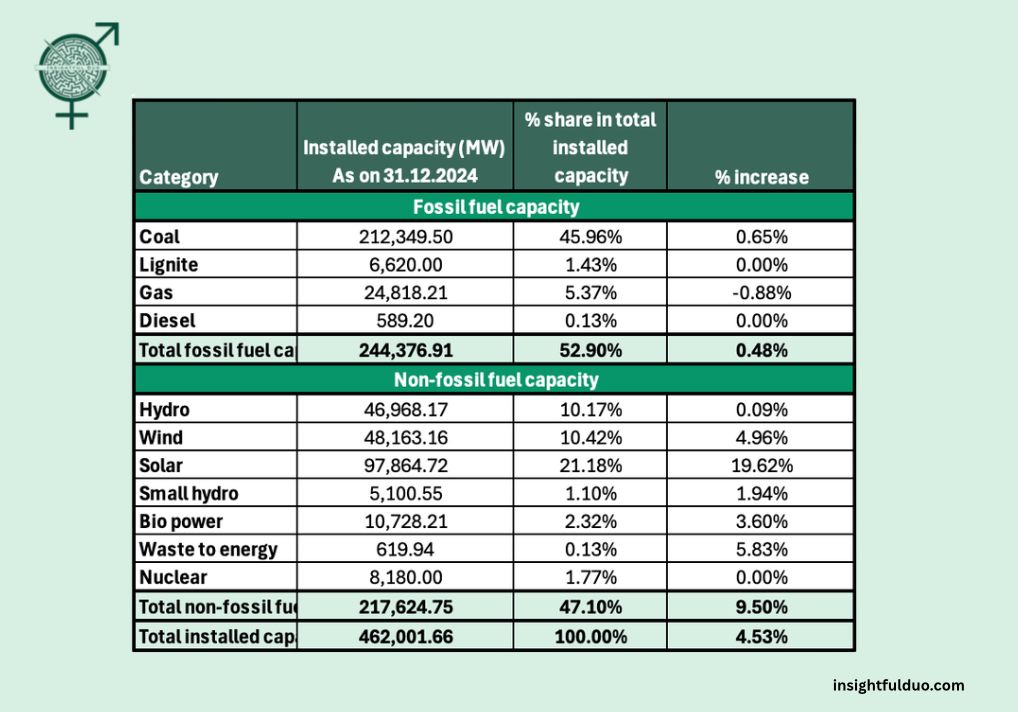
With a foot on the accelerator for growth in renewable energy generation, the government has focused on expanding the electricity generation capacity of India, particularly through non-fossil fuel sources. As of December 2024, non-fossil fuel capacity constituted about 47.1% of the total installed capacity, with solar energy being the major contributor from non-fossil fuel sources. However, the major burden of capacity was still borne by fossil fuels, with 52.9%, with coal-based power plants still dominating the overall electricity production in India in terms of installed capacity.
Despite this continued reliance on coal, the transition toward cleaner energy is clearly visible. The growth rate of solar power plants in India stood at an impressive 19.62%, the highest among all sources, while the expansion in fossil fuel-based capacity remained stagnant or grew by less than 1%. This divergence underscores a strategic shift in India’s long-term energy planning toward sustainable electricity generation.
Generation and Sources of Electricity in India
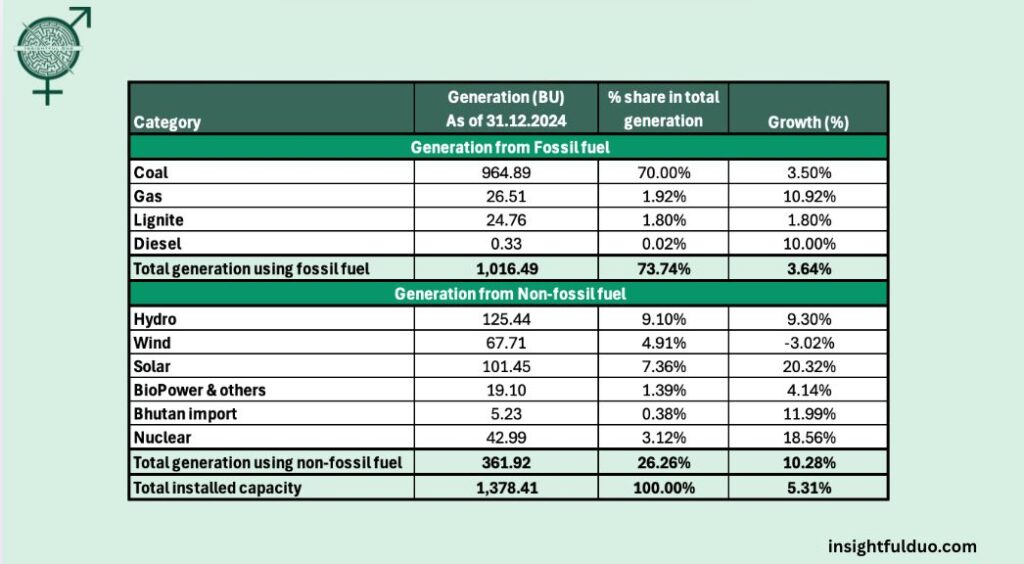
In contrast to the installed capacity, the picture changes significantly when we examine the electricity production in India in terms of actual output from different sources. Despite the growing share of renewables in installed capacity, fossil fuels continue to dominate electricity production in India, accounting for approximately 73.74% of total electricity generated, while non-fossil fuels contribute only about 26.26%. Among the various sources of electricity in India, coal-based power plants alone generate nearly 70% of the country’s electricity, followed by hydropower with a share of around 9.1%.
Nevertheless, the shift in electricity generation capacity of India is reflected in growth trends, where solar energy has emerged as the fastest-growing source. Electricity generation from solar power plants in India recorded the highest growth rate of about 20.32%, indicating a gradual but important transition toward cleaner sources despite the continued dominance of coal.
Understanding Electricity Demand in India
As per the annual report released by the Power Ministry of India, the electricity demand in India has been growing at a compound annual growth rate (CAGR) of 6.19% since 2017-18. This growth has accelerated in recent years due to the rapid expansion of electricity-intensive sectors such as technology, AI, and digital services, which consume significantly more power than traditional economic activities.
Beyond traditional demand drivers such as industry, households, and urbanization, India’s expanding AI and data center ecosystem is emerging as a major source of incremental electricity demand. AI workloads and large data centers run high-performance computing infrastructure around the clock, making them far more electricity-intensive than conventional digital services. In India, rapid expansion of data center capacity is expected to more than triple the sector’s share of electricity demand by 2030.
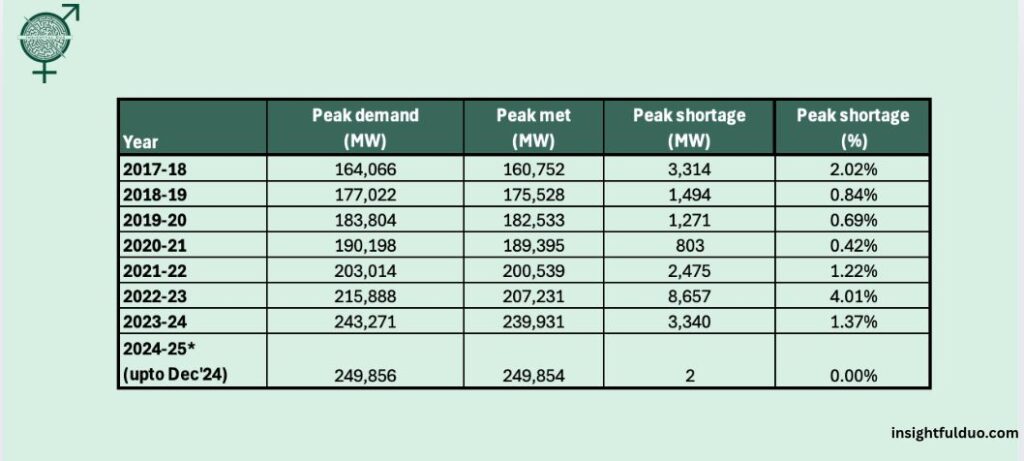
The government claims to have reduced the peak electricity shortage over the years (table above) and to have provided electricity to every corner of India through various campaigns such as Pradhan Mantri Sahaj Bijli Har Ghar Yojana (Saubhagya), Deen Dayal Upadhyaya Gram Jyoti Yojana (DDUGJY), etc. But do these numbers represent a true picture? According to recent reports, there exists a huge power shortage, not just in rural areas but in urban areas too. Whenever the seasonal demand surges, various places in India, be it urban or rural, see long power cuts, which we all experience.
There exist various reports of the same. In May 2025, Aerocity in Chandigarh saw a 17-hour-long power cut. Moreover, other areas in and around Chandigarh witnessed 8 to 17 hours of power cut, despite the Punjab government’s claim of Punjab having surplus power. The same goes for various regions of UP, Maharashtra, etc.
With these long power cuts and an anticipated increase in demand for electricity, India needs to focus on actually delivering the numbers that are being promised and increase the production or supply of electricity for the betterment of its future.
Can India sustainably meet its growing power demand?
As we saw, 70% of total electricity is currently being produced using coal, which has its own harmful effects on the environment. Starting from mining, it leads to land degradation and displacement, and to its usage, leading to air pollution. For India, the goal is not just to meet its electricity demand, but to meet its electricity demand sustainably, which seems unachievable with the majority of its power being produced from coal.
Sustainable production of electricity refers to the production of electricity using sources or raw materials that do not impact the environment badly, while ensuring availability for future generations. The government has also considered this aspect, which is why there is a huge growth of around 20% in electricity produced using solar power plants. Using schemes like PM Surya Ghar: Muft Bijli Yojana, Grid Connected Rooftop Solar Programme (MNRE), etc., the government is trying to promote the usage of solar plants, both at the residential and industrial levels, by offering incentives like subsidies, net metering, and feed-in benefits, letting consumers earn extra money from excess power.
Solar Power Plants in India
As we all know, solar is a clean, renewable, domestically available, and scalable source of energy. And the main advantage is that India has an abundance of solar energy available. Located largely within the tropical zone, India lies between the Tropic of Cancer and the Equator, which means it receives high levels of solar radiation throughout the year, making it well-suited for solar-powered gadgets, be it solar-powered cookers, street lights, water heaters, chargers, or power plants.
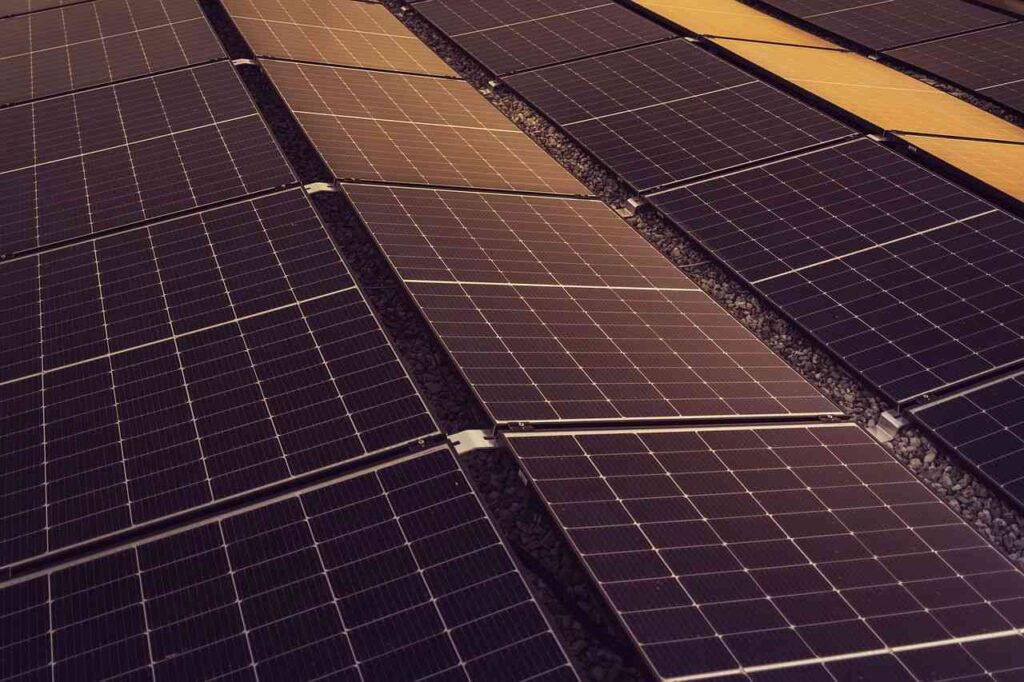
Solar power has emerged as one of the most important pillars of India’s energy transition. Solar power plants convert sunlight into electricity using Photovoltaic (PV) panels. They are the core component of most solar power plants, whether large utility-scale solar parks or small rooftop installations on homes and buildings. At a basic level, PV panels are made of semiconductor materials, most commonly silicon. When sunlight falls on these panels, it excites electrons within the material, creating an electric current. This process is known as the photovoltaic effect, from which the panels get their name. The electricity generated is direct current (DC), which is then converted into usable alternating current (AC) before being supplied to homes, businesses, or the grid.
India’s solar capacity surged to 129 GW in 2025, up from 3 W in 2014, which shows a humongous growth of over 40 times. Nearly 24 lakh households adopted rooftop solar by December 2025 under PM Surya Ghar, with an installation capacity of 7 GW of clean energy, which shows a good adoption rate. Big private players like Adani, Tata, Warre Energies, along with public players like NTPC and Solar Energy Corporation of India (SECI), are playing a major role in the solar energy value chain, be it production or supply. Looking into the future vision, India aims to achieve 500 GW of total non-fossil fuel capacity, with solar forming a larger share.
Conclusion
India is eyeing growth in all aspects, including technology and power. The government is trying to meet the power demand by increasing the overall installed capacity. The highest growth rate in installed capacity is seen for solar power plants. Similarly, with a shift in focus from just electricity production to sustainable electricity production, there is a shift in the share of sources of power production being used. Out of this, solar has again emerged as a source that is getting a lot of attention due to its renewable nature and supposedly low carbon footprint.
While diving deep into the present distribution of the sources used for electricity generation, as well as the electricity demand and deficit, it is evident that India does not need to just increase electricity production but also to focus on reducing the use of fossil fuels and thereby reducing the contribution to air pollution due to electricity production. The generation needs to meet the demand not just in promises but also in the true sense, with minimum power cuts.
Leave a Reply