
Want to take control of your money but don’t know where to start? Learning how to track monthly expenses is the foundation of personal finance. In this guide, you’ll discover why expense tracking matters, how an expense tracker Excel sheet can help, and practical steps to improve your financial literacy.

Salaries increase slowly. Expectations increase faster.
And somewhere in between, the pressure quietly shifts to you—to “manage better.” However, most people with salaries, stipends, or even pocket money feel underpaid and lack money altogether.
From the casual outing on payday to about 10 days after, things change drastically. What started as a month with reasonable spending without neglecting fun turns into a money crunch by the 11th day. And thus starts the next part of the month, filled with confusion and guilt. Cabs turn into walks. Mid-day snacks become optional. “Let’s order” turns into “Let’s skip.” The rest of the month stretches longer than it should. You are checking your bank balance more often than you’d like and wondering where the money went.
Why Personal Finance Feels So Difficult at the End of the Month
Combined with the common misconception that personal finance is just another name for investing, the pressure doubles down to taking care of expenses and investing some of the money as well. However, what is forgotten is that small decisions accumulate to shake the whole month’s budget.
Retrospectively, the problem is assumed to be with salary budgeting and not planning the expenses correctly. While the assumption can be correct, it is more likely not to be. Jumping from the basics of personal finance, more emphasis is given to heavy terms like salary budgeting. In the meantime, as simple a trick as observation can help this feeling of personal finance seeming difficult.
Consider this:
- ₹50 tea three times a day = ₹4,500 per month
- ₹100 auto ride three times a week = ₹1,200 per month
- ₹499 OTT subscription = ₹499 per month
Individually, none of these expenses seems significant. Together, they quietly consume over ₹6,000 every month. These are the money leaks that rarely attract attention but often create the feeling of being constantly short on cash.
Why Salary Budgeting Fails Without Tracking Monthly Expenses
Financial influencers first emphasize the need for salary budgeting. While the necessity of salary budgeting is undeniable, it is also imperative to first be aware of your expenses before estimating them.
Going blindly head-on into estimating your expenses generally leads to underestimating small expenditures and overestimating savings. When fitting a budget, individuals think that they will control their expenses. A surplus created by these underestimated expenditures gives a false hope about savings. Then the negotiation process begins, in which they further underestimate their expenses to see an increasing surplus on paper. And this leads to an important imperative: that you cannot control what you do not measure.
After analyzing your spending patterns, budgeting becomes much easier. Instead of guessing how much you spend, you work with real numbers. The budget stops being an idealized plan and becomes a realistic reflection of your lifestyle. That’s why learning how to track monthly expenses is more important than creating a budget.
Financial Literacy Begins With Tracking Your Expenses
Many people associate financial literacy with investing, stock markets, mutual funds, or retirement planning. In reality, financial literacy starts much earlier. Before learning how to grow money, you need to understand how money currently flows through your life. That means knowing where every rupee comes from and where every rupee goes.
During this observation and tracking phase, the motive is not to control but to gain clarity.
What a Monthly Expense Tracker Reveals About Your Spending
A month’s worth of data analyzed properly reveals a lot. Behaviors, burdens, and patterns seem to emerge. Expenses can be categorized into three broad categories: needs, wants, and savings. The distribution among these broad categories outlines the major burden. Spending 50% of your salary on rent might not be justified for good financial health. Similarly, the case is for ‘wants’; taking up 40% of your salary is going to hurt your pocket.
For example, a student earning ₹15,000 per month might assume that food is the biggest expense. After tracking expenses for a month, they may discover that food delivery, cab rides, and online subscriptions together cost more than rent. Without tracking, these patterns remain invisible. Once visible, they become manageable.
A closer look at further categories shown in the figure below is also needed.
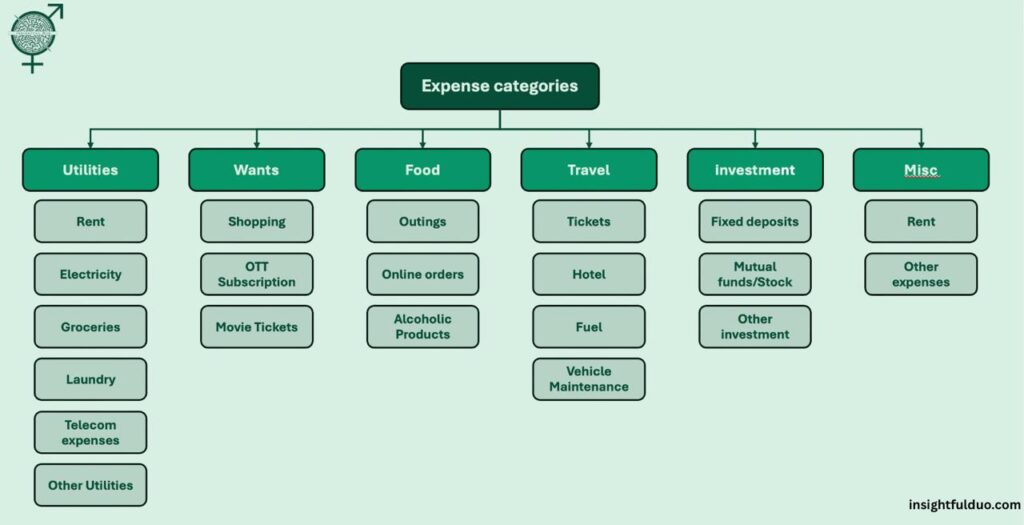
Seeing the percentage of total income taken by different categories reduces emotions and leads to a clearer view of the finances. A clear observation can be made between impulse and necessary expenses.
A Simple Expense Tracker Excel for Beginners
The idea of tracking expenses sounds simple until you try doing it. Apps demand permissions, and you have to work on small screens. Manual tracking is tiring. For beginners, Excel seems too complicated. This makes beginners quit after a short while.
A good system should:
- Take 5-10 minutes daily
- Not require advanced Excel knowledge
- Automatically summarize monthly data
- Show percentage breakdown by categories
- Separate needs, wants, and savings
- Handle shared expenses
- Handle credit card cycles
The challenge is that awareness requires consistency. Most people start tracking expenses enthusiastically but stop after a few days because the process feels tedious. A system that is simple enough to use every day is often more valuable than a sophisticated system that gets abandoned after a week.
To solve this problem, we created a simple monthly expense tracker in Excel designed specifically for beginners. It is beginner-friendly and has a clean layout, including a monthly dashboard and an income tracker sheet. The dashboard captures various insights to better understand expenses, income, and investments.
Conclusion
Feeling broke is rarely about income. More often, it is about invisibility.
When money moves without your awareness, it creates confusion. When you start observing it, patterns emerge. And once patterns become visible, better decisions follow naturally.
Financial growth does not begin with investing, budgeting, or finding the perfect savings strategy. It begins with awareness. And awareness begins with tracking.
If you’re ready to stop guessing and start seeing your numbers clearly, a structured system makes the process easier. A simple monthly expense tracker can turn scattered transactions into meaningful insights—showing you exactly where your income flows, how much goes to needs and wants, and what truly remains for savings.
That’s exactly why we created a beginner-friendly monthly expense tracker in Excel—clean, practical, and designed to take just a few minutes a day while automatically summarizing your month for you.
Because once your money becomes visible, it becomes manageable.
Leave a Reply