As India’s electricity demand continues to rise, solar power is emerging as a key alternative to coal-fired electricity generation. This article explores the working and types of solar power plants, installation costs, and government subsidies. It also examines the current state of solar power in India, its contribution to electricity generation, and its role in the country’s energy transition.
India’s electricity demand is rising. With India positioning itself as a lucrative manufacturing destination, inviting domestic and global companies to set up their manufacturing plants here, and with technological advancements, including the setting up of data centers in the country and AI adoption, the demand for electricity is expected to increase by 6.4% annually over the period of 2026-2030. Generating electricity from solar power plants is not just an alternative source, but it’s a necessary step for India. Given that more than 70% of India’s electricity is produced using coal, to fulfill India’s commitment to control global warming and air pollution, solar power is becoming an increasingly important part of the global energy landscape.
But what is a solar power plant, how does it operate, how does sunlight get converted into electricity, how many types of solar power plants are available, and is this alternative sustainable for India or not? Below, we’re going to try to find the answers to these questions and see if solar power plants can reduce dependence on coal-fired electricity generation.
Working of a Solar panel: How does a solar power plant generate electricity?
Let’s firstly get clear on the basic definitions of the words which are often used interchangeably.
- Photovoltaic effect: The word is made up of two words – photo and voltaic. Photo means light, and voltaic means voltage or electricity, so it’s a process of converting light, or in this case sunlight, into electricity.
- Solar cell: These are the units that convert sunlight into electricity. It is made of a semiconductor material, mostly Silicon.
- Solar module/Solar panels: A solar module consists of multiple solar cells connected together.
- Solar strings: It is a group of multiple solar panels/modules connected together.
- Solar Array: It consists of multiple solar strings connected together.
- Solar power plant: It is a larger system that uses solar arrays and other electrical equipment to generate electricity, typically at a scale large enough to supply electricity to the grid.
- Direct current (DC): Electric charge flows steadily in only one direction with a constant polarity.
- Alternating current (AC): Electric charge periodically reverses direction and changes its magnitude continuously over time.
Sunlight consists of tiny packets of energy called photons. Solar cells are photovoltaic devices. They absorb the sunlight, which makes the negatively charged particles called electrons, already present in the solar cell, move from their place and leave behind what are known as “holes”. The electrons move through the electrical connections, producing electric charge in the presence of sunlight. This movement of charge is what we call electric current.
The produced electric current is direct current. It can be stored in a battery and/or can be used to power multiple appliances. However, most of the appliances used in homes need alternating current to work, so an inverter is used, which converts direct current to alternating current to power the appliances.
While charging the battery, an oversupply of electricity during the sunny day or drainage of power from the battery to the panel can occur during the night time; hence, a charge controller is used. All the electricity produced by the solar panel is passed through the charge controller, which regulates charging and discharging in battery-based systems, hence controlling the supply to the battery by either supplying the extra units of electricity to the grid or to power appliances and restricting the current flow from the battery back to the panel.
Types of Solar Power Plants
Solar power plants can be classified based on:
Where they are installed
- Ground-mounted solar power plants: Panels are installed on structures fixed to the ground, generally for larger utility-scale projects.
- Rooftop solar power plants: Panels are installed on the roofs of homes, offices, factories, and other buildings.
- Floating solar power plants: Panels are installed on floating structures over reservoirs, lakes, or other suitable water bodies. As solar power plants require considerable space to produce electricity in vast amounts to support industrial and advanced tech requirements, floating solar systems are becoming a viable option for governments.
Whether they are connected to the grid
- On-grid solar system: It is kind of a solar system that is connected to the electricity grid, can supply electricity to the building/grid, and doesn’t necessarily require batteries.
- Off-grid solar system: It is the kind of solar system that is not connected to the conventional grid, usually requires batteries to store electricity, and is useful where grid electricity isn’t available or reliable. The Ministry of New and Renewable Energy (MNRE) specifically describes off-grid solar applications for areas where grid power is unavailable or unreliable.
- Hybrid solar system: It is the kind of solar system that is connected to the grid and equipped with battery storage. So users can use solar systems to power appliances, store excess electricity, and draw from the grid when required.
Solar Power Plant for Home
Rooftop solar systems are a popular choice for households looking to harness solar energy and reduce their dependence on grid electricity. However, choosing the right solar power plant for home involves considering several factors, including the system’s capacity, whether an on-grid or off-grid setup is more suitable, the available rooftop space, installation costs, and applicable government subsidies.
The ideal capacity of a residential solar system largely depends on the household’s monthly electricity consumption. For many Indian homes, systems ranging from 2 kW to 5 kW can be suitable, depending on the size of the household and its energy requirements. Larger homes, such as villas with higher electricity consumption, may require systems of 8 kW or more.
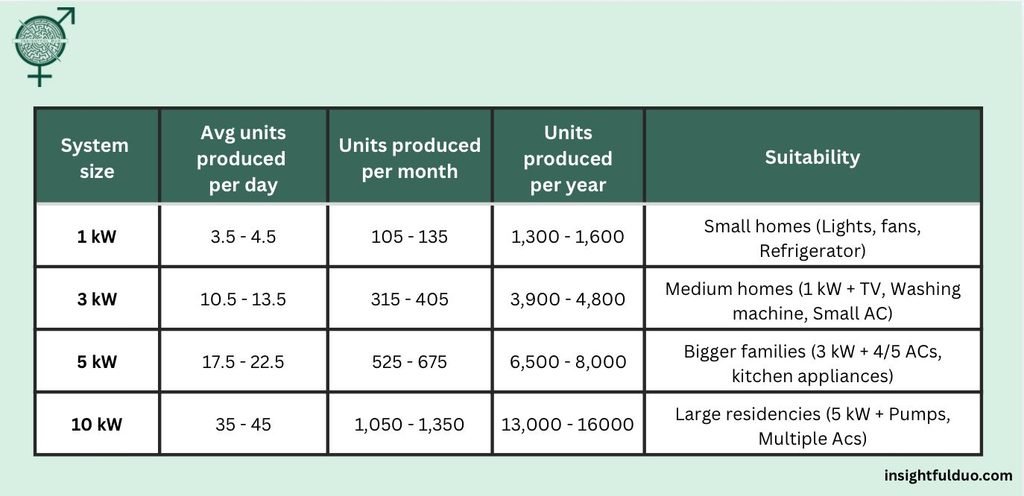
As claimed by one of India’s largest solar power plant manufacturers.
Choosing between the on-grid setup and off-grid setup depends on factors like the grid supply and whether the household wants to go with the on-grid supply during night time or the battery-powered system. If the area has unreliable grid supply and frequent and long power cuts, it’s better to go with an off-grid setup, while if there are lower electricity bills or per-unit charges, better ROI, and reliable supply of electricity, on-grid connections can be preferred.
The required rooftop space availability is also one of the important factors to consider because a minimum of 200 sqft of space is required for setting up a small solar power plant of 2kW capacity, and it increases as the size of the system increases.
Cost of Solar Panels
The cost of solar panels depends on a wide range of factors like:
- Capacity of the Solar Power System: The capacity of the system is a primary factor determining its cost, as higher-capacity systems require more solar panels and may need larger inverters and additional equipment. The gross cost of the system varies from an average of ₹120,000 to ₹340,000 for systems with a capacity of 2kW to 5kW.
- Quality of Solar Panels, Inverters and Mounting Structures: The efficiency, durability, brand and warranty of the components influence the overall cost of the system.
- Installation Charges: Labour costs, roof accessibility, wiring requirements, and the complexity of installation can affect the total expenditure.
- Net-Metering and Grid-Connection Requirements: On-grid systems may involve additional costs for metering equipment, grid connection and approvals, depending on local regulations and distribution company (DISCOM) requirements.
- Battery Storage and Backup Requirements: Off-grid and hybrid systems may require batteries to store electricity for later use, increasing the initial installation cost.
Battery storage can increase the upfront investment, so an on-grid system without batteries may cost less than an otherwise comparable system with storage.
Government Solar Scheme and Subsidy
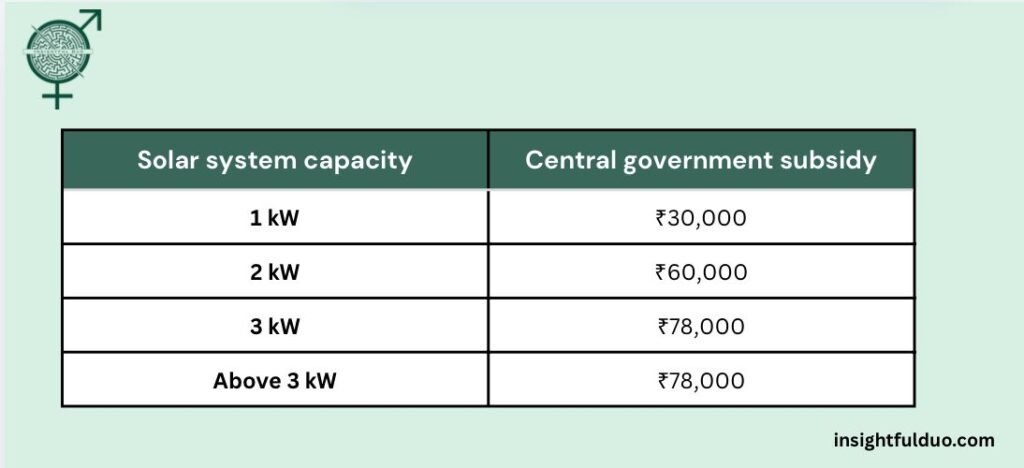
The Government of India offers subsidies to encourage households to adopt rooftop solar systems and accelerate the transition towards cleaner sources of energy. In 2024, the government launched the PM-Surya Ghar: Muft Bijli Yojana, a scheme designed to make rooftop solar installations more affordable for residential households.
Under this scheme, eligible households can receive central government financial assistance of up to ₹78,000, depending on the capacity of the solar power system installed. The subsidy amounts applicable to different system capacities are outlined below.
Current State of Solar Power
The government claims that more than 59.5 lakh households have benefited within 2.5 years of the launch of PM Surya Ghar Bijli Yojana, and it has been targeted to reach 1 crore households by 2030. The current installed solar power plant capacity is 1.7 Lakh MW as of 30th September 2026, which was 1.05 lakh MW by 31st March 2025. Solar power contributed about 26.44% of the total installed capacity by the end of the year 2025.
However, the state of power generation is a little different. Solar power contributed only about 8.81% of total electricity generated in India by the end of the year 2025.
The Future of Solar Power
India’s growing electricity demand makes the expansion of the solar power system an important part of its energy transition. From large ground-mounted and floating solar power plants to rooftop systems for households, solar energy offers multiple ways to generate cleaner electricity. Government initiatives such as the PM-Surya Ghar: Muft Bijli Yojana also make rooftop solar more accessible by reducing the upfront cost for eligible households.
However, solar power alone cannot meet every electricity requirement at all times. Greater energy storage, stronger grid infrastructure, and a diversified energy mix will be essential to ensure a reliable supply. Rather than replacing coal overnight, solar power can help India gradually reduce its dependence on coal-fired generation while meeting its growing energy needs more sustainably.
Leave a Reply