
E20 petrol is changing the way India fuels its vehicles, but the transition comes with both benefits and trade-offs. This guide explains what E20 petrol is, its advantages and disadvantages, its impact on mileage and emissions, vehicle compatibility, and how it compares with normal petrol.
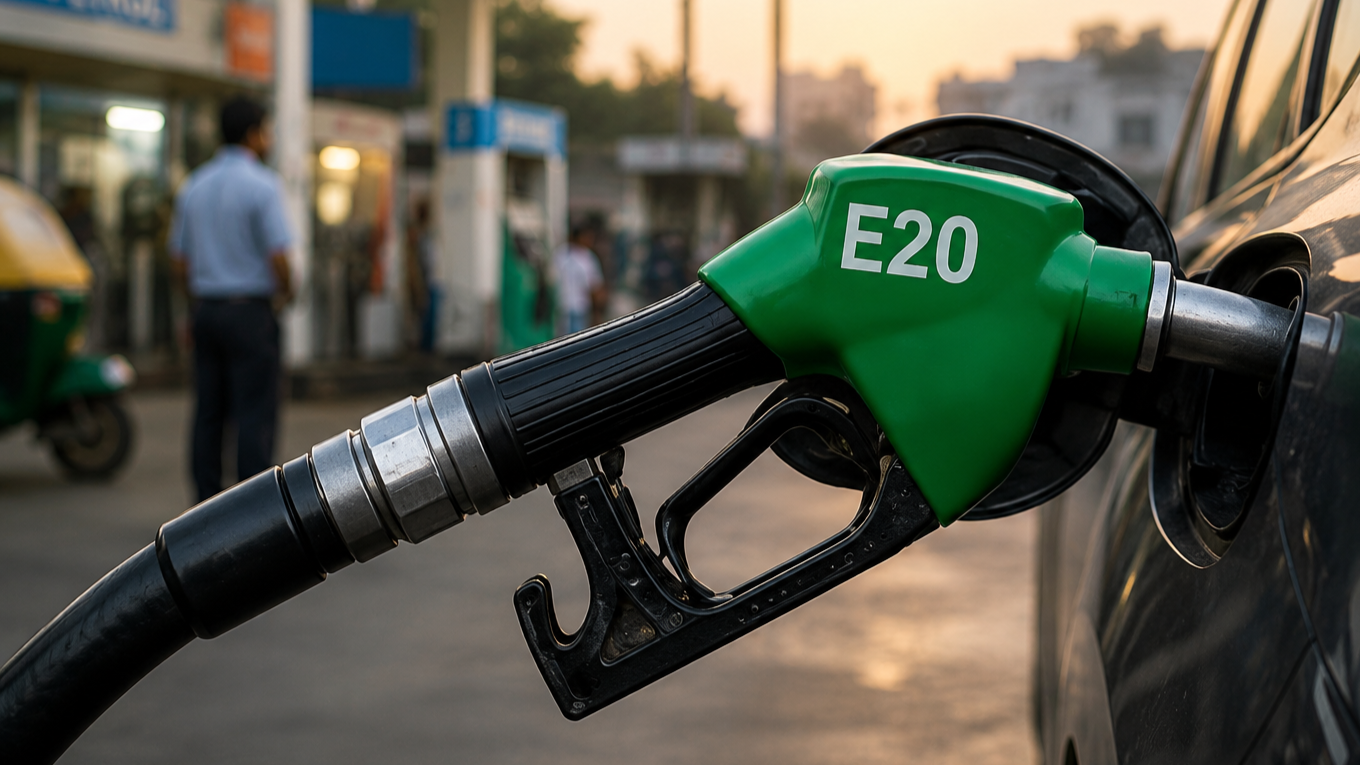
You’re standing at the petrol pump, watching the numbers on the dispenser climb higher with every passing second. While waiting, your eyes wander towards the fuel nozzle and settle on a small sticker you’ve probably seen dozens of times without thinking much about it.
It isn’t advertised like premium petrol. Nobody at the fuel station stops to explain what it means. Yet that tiny label represents one of the biggest changes India’s fuel landscape has seen in decades.
The transition didn’t happen overnight. It arrived quietly, one refinery at a time. One fuel tanker at a time. One petrol station at a time.
Today, millions of vehicles across India are already running on E20 petrol, often without their owners even realising the switch has happened.
Which raises an obvious question.
What exactly has changed inside the fuel? What is E20 petrol?
At first glance, almost nothing. The colour is the same. The smell is familiar. Your engine doesn’t suddenly sound different the moment you leave the petrol station.
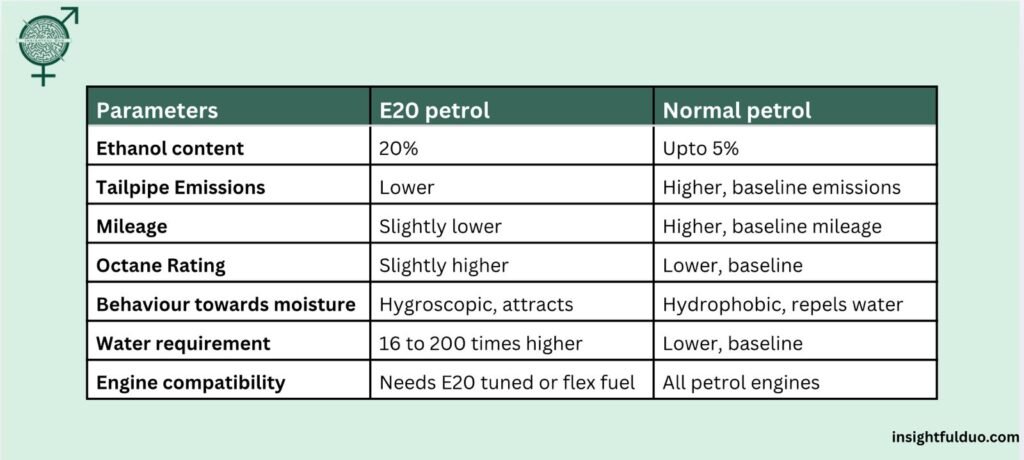
The biggest difference is hidden at the molecular level. Traditional petrol is made entirely from petroleum-derived hydrocarbons. E20 petrol, on the other hand, contains 20% ethanol and 80% petrol.
That may not sound like a dramatic change. In reality, it changes the way the fuel burns.
Ethanol is a renewable alcohol produced from agricultural feedstocks such as sugarcane, maize, and rice. Once processed, it can be blended safely with conventional petrol before reaching fuel stations.
Unlike petrol, ethanol naturally contains oxygen within its molecular structure. That extra oxygen allows the fuel-air mixture to burn better, helping reduce emissions such as carbon monoxide and unburnt petrol. Older petrol cars tend to produce less unburnt fuel with E20 petrol. However, modern engines already use sophisticated air-fuel control systems that leave very little unburnt petrol behind regardless of the blend.
The story becomes slightly more complicated when it comes to nitrogen oxides (NOx). Some older vehicles have shown an increase in NOx emissions after switching to E20 petrol, whereas newer vehicles generally show little to no statistically significant change. In many modern engines, ethanol blends have even been found to produce lower NOx emissions than conventional petrol.
Carbon dioxide emissions, interestingly, don’t change very much at the tailpipe. Studies have found no consistent or statistically significant difference in CO₂ emissions between conventional petrol and E20 petrol during normal vehicle operation.
Researchers have also observed an increase in certain oxygenated compounds such as acetaldehyde in some vehicles running on E20 petrol. In one study, acetaldehyde emissions were roughly three to three-and-a-half times higher than those measured with regular petrol. However, this wasn’t observed across every vehicle tested, highlighting that engine design plays a major role in determining emissions.
But the tailpipe emissions aren’t the entire story.
Ethanol also contains less energy per litre than petrol. To produce the same amount of power, an engine generally needs to burn slightly more fuel.
So does that mean your mileage is about to suffer?
Since E20 petrol contains around 5% less energy per litre than conventional petrol, engines generally need to burn a little more fuel to produce the same amount of power. For most drivers, that translates into a modest reduction in mileage. Experimental testing has consistently shown fuel economy declining as ethanol concentration increases, although the exact difference varies from one vehicle to another depending on engine calibration, driving conditions, and vehicle age.
There’s another characteristic that receives far less attention.
Ethanol is hygroscopic, meaning it attracts and absorbs moisture more readily than petrol. This causes ethanol-blended petrol to absorb water faster than pure gasoline, and under prolonged humid storage, it can lead to separation of petrol and ethanol, especially if the tank breathes humid air. This can lead to engine stalling, corrosion, and component damage.
None of these characteristics automatically makes E20 petrol better or worse. They simply make it different. The impact, really, depends on the design and manufacturing of the car.
Which brings us to the question every vehicle owner eventually asks.
Can Your Car Actually Use E20 Petrol?
The answer depends far more on your vehicle than on the fuel itself.
Over the past few years, most manufacturers have been asked to gradually redesign petrol engines and fuel systems to handle higher ethanol blends. Many recently launched cars already mention E20 petrol compatibility in their owner’s manuals.
For owners of these vehicles, the transition is likely to be almost invisible.
Fill up. Drive. Repeat.
The loss in fuel economy is also minimal. Modern engines are increasingly calibrated to recover part of that loss, which is why tyre pressure, maintenance, and driving habits often have a bigger impact on mileage than the fuel itself.
Additionally, E20-compatible cars use sealed fuel systems, making moisture contamination extremely uncommon during normal use.
On the other hand, an older vehicle doesn’t automatically mean you’ll face engine failure or expensive repairs overnight. It simply means compatibility should be verified rather than assumed. The most reliable source isn’t a YouTube mechanic or an online forum.
It’s your owner’s manual.
If the information isn’t available there, your vehicle manufacturer or authorised service centre can confirm whether your particular model is compatible with E20 petrol.
Compatibility is an engineering question – not an internet debate.
The owners of older vehicles will experience the transition from conventional petrol to ethanol-blended petrol a little differently. Even though there will be a drop in the mileage of the vehicle, there is no instant damage. Cars manufactured before E20 petrol became part of India’s long-term fuel strategy may contain rubber seals, plastic components, or fuel lines that weren’t originally designed for prolonged exposure to higher ethanol concentrations. These parts may need attention if and when suggested by your authorised service centre.
Since pure petrol does not attract moisture, the fuel system in older vehicles is not as tightly sealed as in E20-compatible vehicles. Hence, older vehicles or cars left parked for several weeks at a time are more susceptible to moisture-related fuel issues. However, in normal vehicle use with regular fuel turnover, the risk is much lower than in long‑term storage.
Why was ethanol blending introduced in India? Advantages of E20 Petrol
If E20 petrol comes with compromises, why introduce it at all?
The answer has surprisingly little to do with your car. It has much more to do with the country’s energy strategy and economy.
India’s primary motivation is straightforward. The country imports a significant portion of the crude oil it consumes, leaving fuel prices heavily exposed to global markets. Every litre of domestically produced ethanol blended into petrol slightly reduces that dependence—leading to a higher GDP for the country.
For some years, petrol sold across India was primarily E10, containing 10% ethanol. Today, that blend has largely shifted to E20, which was targeted for 2030.
Though on paper, another ten per cent doesn’t sound particularly dramatic. However, looking at a larger scale across billions of litres of fuel, it creates a very big impact. India’s ethanol blending programme has reportedly saved more than ₹1.90 lakh crore in foreign exchange since 2014.
The secondary selling point given by the government was the promise to provide cheaper petrol.
However, there are other advantages of E20 petrol as well. Some of them are:
- Environmental benefit: It helps lower emissions of pollutants such as carbon monoxide, carbon dioxide, unburnt petrol, particulate matter, and other emissions. While it won’t eliminate urban air pollution, it represents one practical step towards cleaner transport.
- Higher octane rating: Ethanol’s higher octane rating elevates the octane rating for the ethanol-blended petrol. This leads to improved antiknock characteristics and better engine running for E20-compatible vehicles.
- Increases demand for crops: Ethanol is produced using crops like sugarcane, maize, and surplus food grains, giving farmers an additional market for their harvest. During years of surplus production, that extra demand can provide greater income stability instead of allowing crops to go unsold.
- Generation of rural jobs and industrialisation: Establishment of distilleries generates rural jobs and promotes rural industrialisation.
But again, this all seems too good to be true kind of a deal – so this is not the whole story.
Disadvantages of E20 Petrol
Since we have seen so many benefits of E20 petrol, why do we hear negative news about it? Because no large-scale energy transition comes without compromises.
Let’s now discuss the disadvantages of E20 Petrol:
- Reduction in fuel economy: Since ethanol contains less energy per litre, some vehicles will travel slightly fewer kilometres on a full tank. The reduction is generally modest, but it does exist.
- Large water requirement: Producing ethanol is highly water-intensive. Studies report that the life-cycle footprint of ethanol production in India ranges between 230 and 7150 litres per litre of ethanol. This is to be compared with the footprint of petrol, which is around 2.8 to 6.6 litres of water per litre of petrol.
- Increased emission of acetaldehyde: E20 petrol can increase emissions of certain oxygenated compounds, particularly acetaldehyde. Acetaldehyde is a respiratory irritant and is considered a potentially cancer-causing air pollutant. However, the increase wasn’t observed consistently across all vehicles.
- Long-term compatibility: Modern vehicles use ethanol-resistant materials throughout their fuel systems. Older vehicles may not. Over time, higher ethanol concentrations can gradually accelerate wear in certain rubber seals, plastic components, and fuel lines that were never designed for ethanol. This isn’t about engines suddenly failing after one tank of fuel. It’s about long-term material compatibility.
E20 Petrol vs Normal Petrol
Where Does India Go From Here?
The small E20 sticker on the fuel dispenser represents something much larger than a different fuel blend. It signals where India’s automotive industry is heading.
Manufacturers are already introducing flex-fuel vehicles capable of running on even higher ethanol blends, while engineers continue refining engines to minimise the mileage penalty and improve efficiency.
The government is pushing to increase the ethanol blend in petrol. It has already introduced E85 petrol. The intentions are clear: reduce the usage of crude oil and increase the usage of flex fuel.
While the motivation behind ethanol blending is positive, the advantages and disadvantages of E20 petrol should be weighed carefully. In the hope of reducing air pollution and strengthening the economy to improve living standards, depleting the nation’s water reserves seems counterintuitive and ironic. The production requires thousands of litres of water for the production of a single litre of ethanol.
With ongoing groundwater depletion and projections that groundwater levels could reach zero in metro countries within the next 5 years, India needs to make a sustainable choice for its future.
Final Thoughts
The next time you stop at a petrol pump and notice that familiar E20 sticker, you’ll probably look at it a little differently. It isn’t just another government label on a fuel dispenser.
It depicts some of the changes the “petrol” has gone through in recent years. From pure petrol to E10 petrol to E20 petrol. The technical reports show both advantages and disadvantages of ethanol blending.
Generally speaking, there are many advantages and disadvantages of E20 petrol. It is a large transformation involving water depletion, cleaner emissions, lower mileage, reduced dependence on imported crude oil, and a long-term shift in how India powers its vehicles.
However, ethanol production was claimed to be cheaper. E20 petrol should have become cheaper than conventional petrol. Moreover, the sudden transition from conventional petrol to E20 petrol gives consumers less time to understand and adopt the change.
For owners of modern, manufacturer-approved cars, E20 petrol or pure petrol does not make any difference. However, for owners of older vehicles, the transition is going to be visible over a long time. Components not compatible with ethanol will require replacements or repairs, not suddenly but slowly.
In the end, it is not just about the intentions. The decisions undertaken by the government are the stepping stone for future generations. If today’s decision can endanger the air and water supply, then we need to stop and re-evaluate.
Leave a Reply